
If you’ve ever guessed whether a pizza stone was truly preheated, wondered if a griddle was running hot at the edges, or needed to sanity-check an AC vent without pulling out tools, you’ll understand why we picked up the Etekcity Temperature Gun Infrared Thermometer (Lasergrip 1260). Over the past couple of weeks, we’ve used it everywhere we reasonably could: across a roaring pizza oven, over cast-iron on the grill, inside the fridge and freezer, along HVAC registers, by the pool surface, and even around the car engine bay.
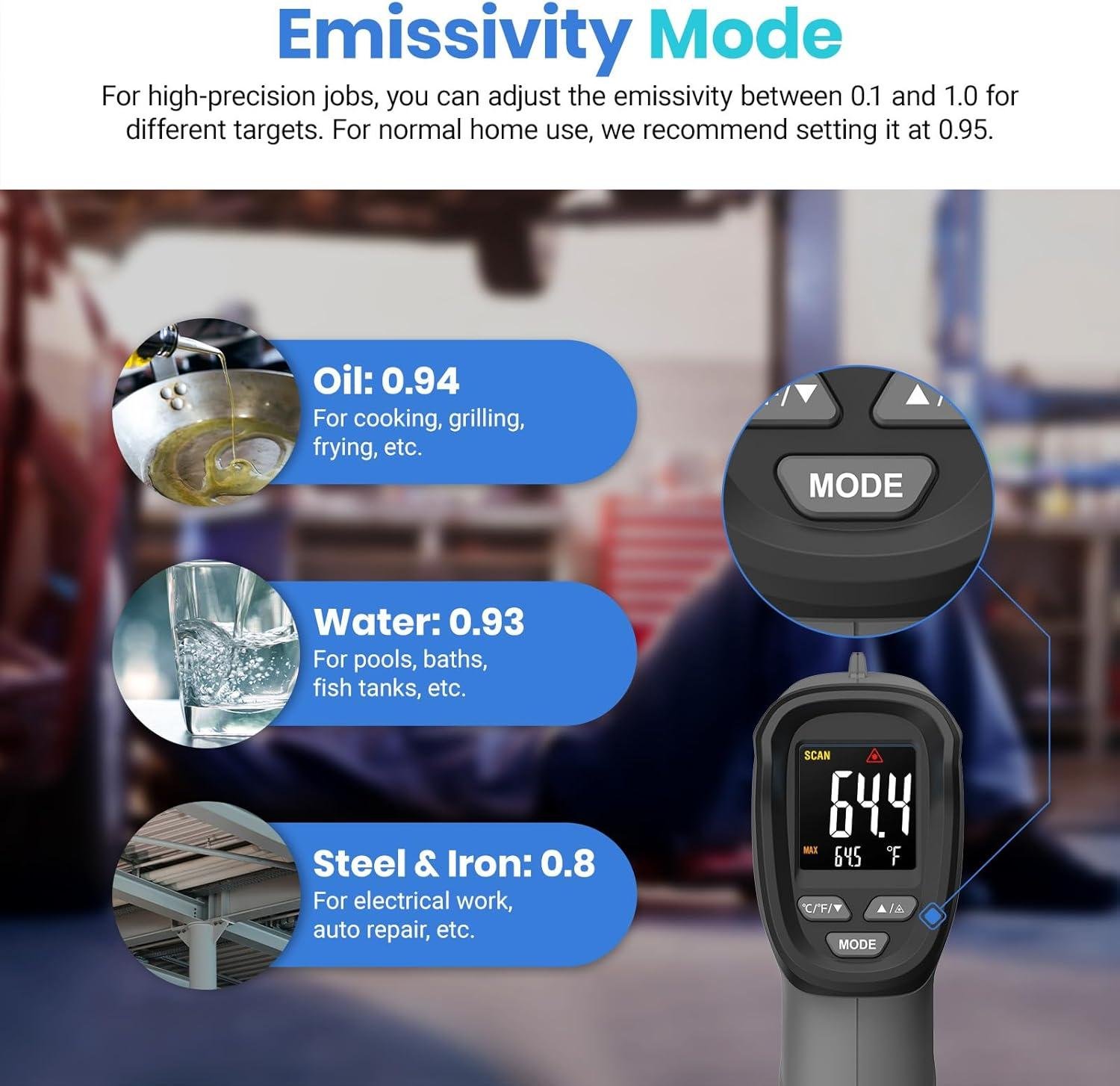
Out of the box, the Lasergrip 1260 feels solid in the hand, with a straightforward, one-trigger operation. The color LCD is easy to read at a glance, and the “Max” readout has been handy when scanning across a hot surface. We appreciated the adjustable emissivity (0.1–1.0) when moving from matte cast iron to shinier stainless surfaces—after a little trial and error, dialing it toward the recommended 0.95 for most household tasks gave us consistent results. The response is snappy, roughly half a second, and the 12:1 distance-to-spot ratio worked well provided that we respected how close we needed to be for smaller targets.
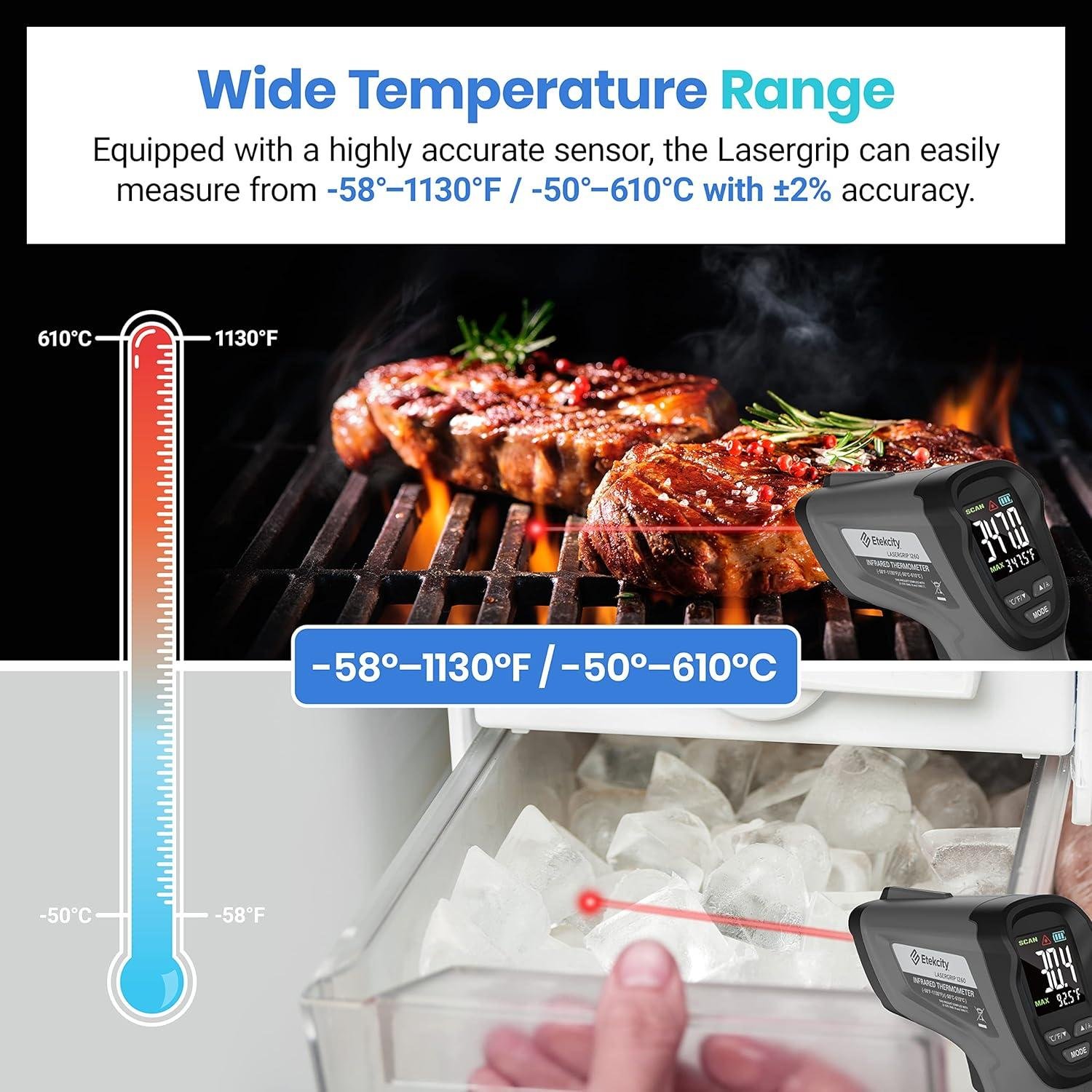
Etekcity rates the thermometer from -58°F to 1130°F with ±2% accuracy, which comfortably covered everything we tested, from freezer walls to the heart of a pizza oven. It locks a reading after we release the trigger and holds it on-screen long enough to jot down notes. And while it’s tempting to check skin or bath temperatures this way, it’s worth repeating: this is not for human or medical use.
In this review, we’ll walk through where the Lasergrip 1260 impressed us, where it asked for a bit of technique, and whether it earns a permanent spot in our kitchen-and-garage toolkit.
Our Overview After Weeks With This Temperature Gun
After weeks of daily checks—from pizza stones and griddles to A/C vents, freezers, and an engine bay—we came away impressed by its reliability and ease. The color LCD makes results and Max readings pop, while the adjustable emissivity (0.1–1.0) let us fine-tune accuracy; 0.95 handled most household surfaces, and dropping it or using matte tape helped on reflective pans. With a 12:1 distance-to-spot ratio, we measured safely without crowding heat, and the quick ~0.5 s response plus a 15‑second display lock reduced retakes. The grip feels balanced, the laser pointer is precise, and switching °C/°F is instant. Note: it’s not for human use.
- Consistent readings from deep-freeze to blazing-hot stone (within the claimed ±2%).
- Trigger-and-go convenience; auto-off preserves the 2×AAA batteries.
- Luminous, readable display indoors and out.
- Respect spot size—tiny targets require getting closer.
- Reflective metal benefits from emissivity tweaks or matte tape.
| Spec | what We Saw |
|---|---|
| Range | -58°F to 1130°F covered every task we tried |
| Response | ~0.5 s, near-instant feedback |
| Emissivity | 0.1–1.0,quick to adjust |
| D:S | 12:1,accurate at practical distances |
| Accuracy | ≈±2% in our checks |
| Hold | max capture + 15 s screen lock |
Our takeaway: as a kitchen-to-garage workhorse,it removes guesswork for griddles,pizza ovens,A/C diagnostics,refrigerators,and even pet habitats.The learning curve is mostly about emissivity and spot size,but once dialed in,it’s fast,consistent,and genuinely useful. Battery life was solid, the laser pointer kept aiming honest, and the display stayed legible in varied light. Want to put precise temps at your fingertips? Check price and availability
Features And Design Details That won Us Over
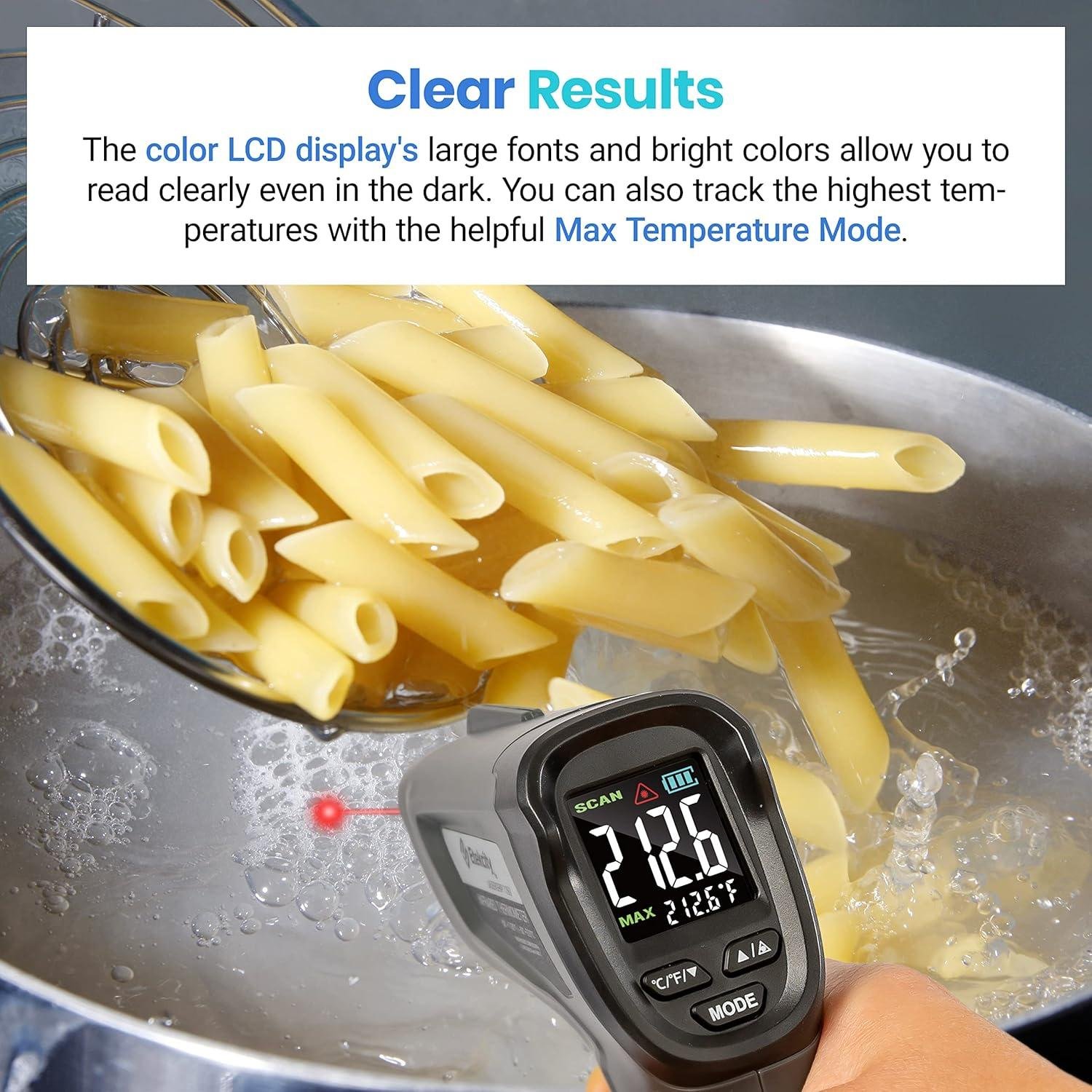
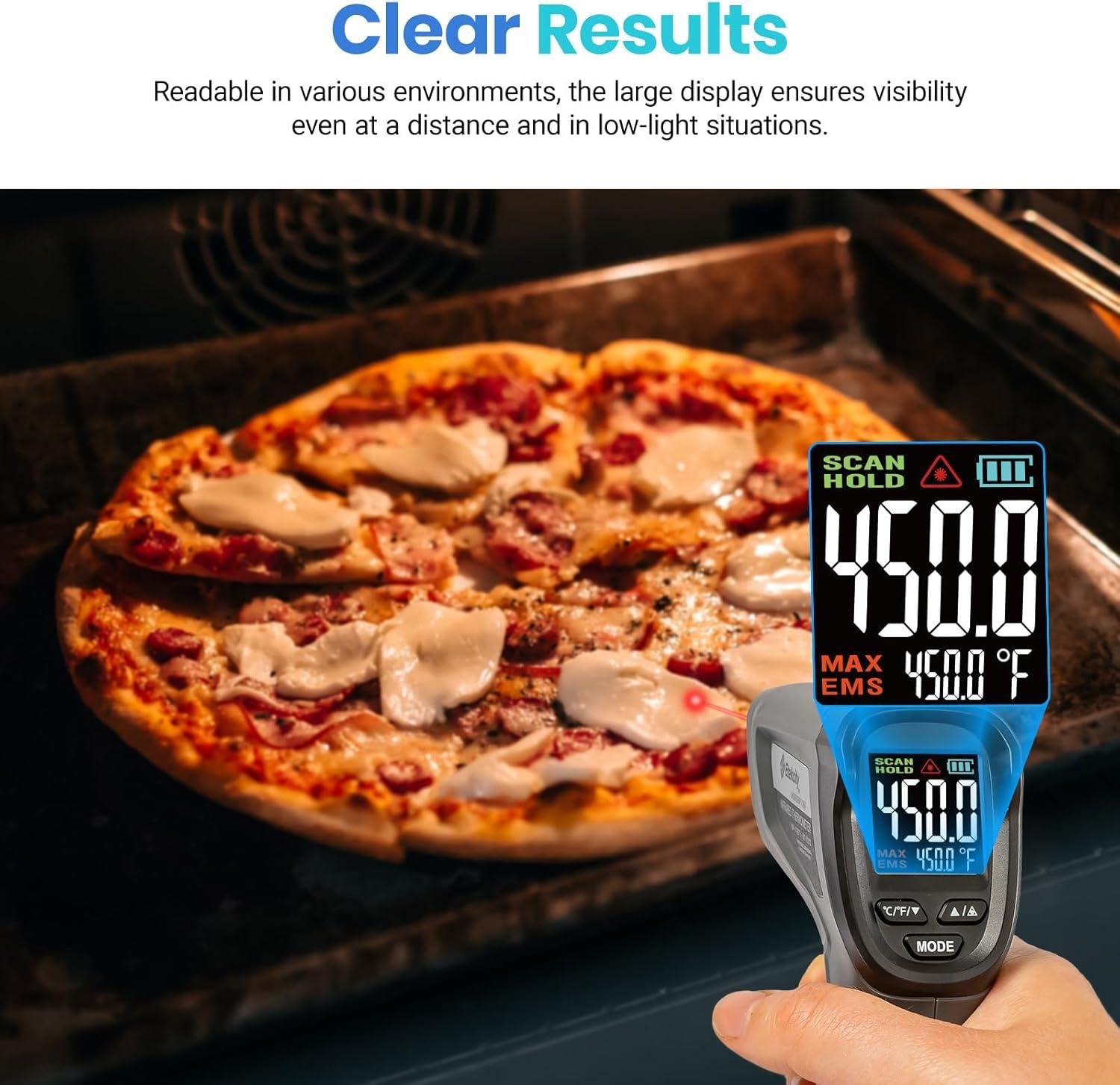
Thoughtful ergonomics meet rapid precision in this Lasergrip redesign. The comfortable grip and single-trigger control make spot checks effortless,while the color LCD presents current and MAX readings in large,easy-to-see fonts. We appreciate the non-contact laser aim that keeps us at a safe distance (12:1 D:S), the 0.5s response time for fast workflows, and the simple switch between °F/°C. Releasing the trigger locks the reading on-screen for 15 seconds, then it auto-sleeps to save battery—smart touches that add up during busy sessions.
- Wide range: -58°F to 1130°F (±2% accuracy)
- Adjustable emissivity: 0.1–1.0 for better accuracy on different surfaces (we stick to 0.95 for most home tasks)
- MAX hold: Instantly spot peak heat on ovens, griddles, or engine parts
- Clear visuals: Color display with bold digits for quick reads
- Practical details: 0.1° increments, repeatability 1%/1°C, 2×AAA power
- Safety note: Not for measuring human temperature
| Task | Why We Liked It |
|---|---|
| preheating a pizza stone | Perfect crust timing with MAX hold |
| Seasoning a griddle | Hits the oil’s ideal polymerization temp |
| Checking A/C vents | Fast diagnostics without tools |
| Engine bay hotspots | pinpoint issues from a safe distance |
| Freezer calibration | Consistent storage temps |
| Reptile habitat | Comfortable basking zones |
Versatility is the headline here: we’ve used it across ovens and pizza stones, griddles, grills, A/C registers, fridges and freezers, car engines, pools, DIY projects, and pet environments—all without touching the surface.The laser guidance helps us aim precisely, and tunable emissivity keeps readings honest on everything from matte cast iron to glossy tiles. If you want quick, reliable spot checks that fit in one hand, this compact workhorse earns its place on the tool rack. Check current price and see details
Accuracy Usability And Real World Performance Across Kitchen Garage And Pool
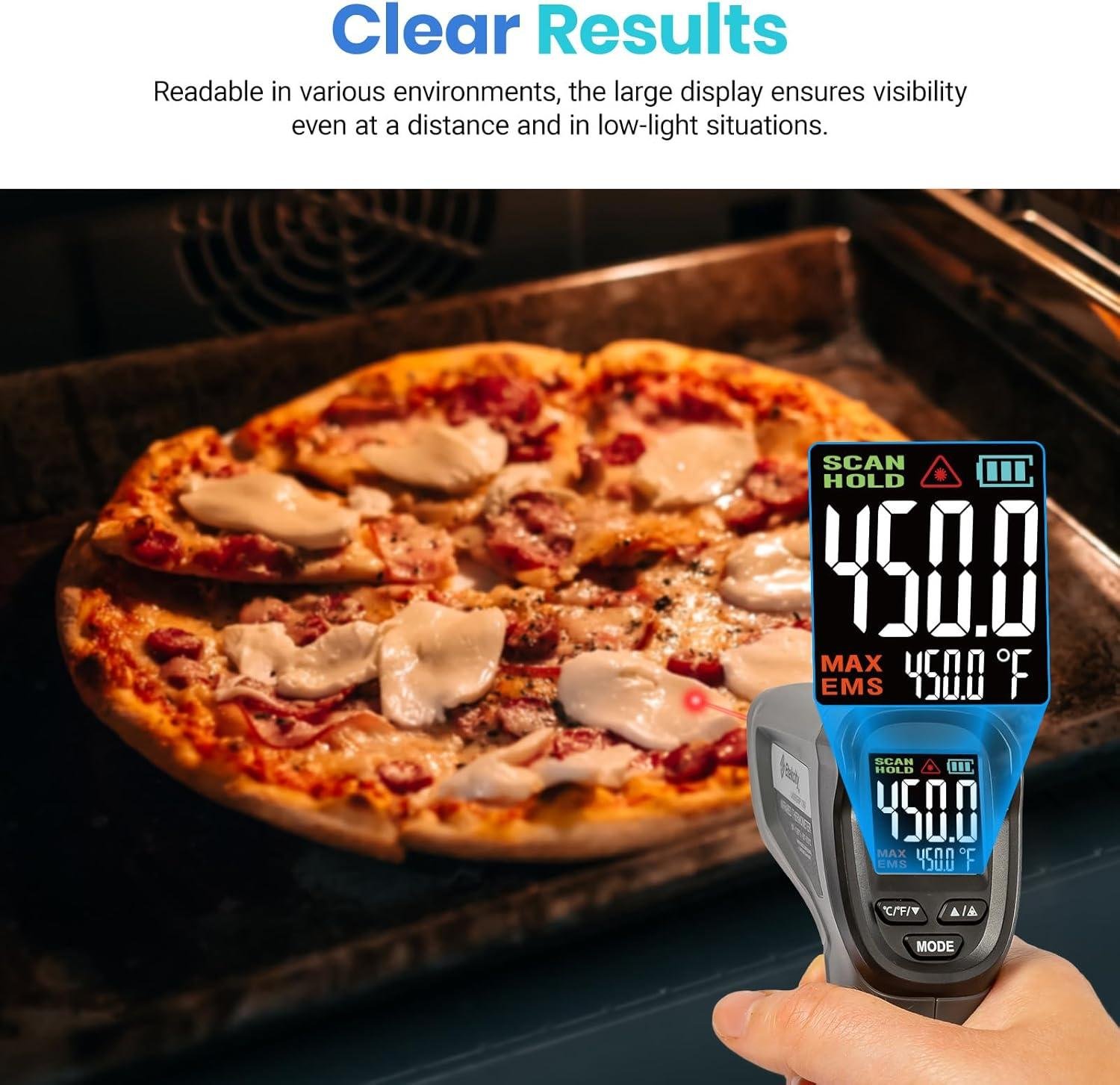
Accuracy holds up across our kitchen, garage, and pool checks thanks to a wide -58°F to 1130°F range, ±2% spec, and a fast 0.5 s response. The adjustable emissivity (0.1–1.0) lets us dial in for different surfaces, with 0.95 working well for most household tasks. A 12:1 distance-to-spot ratio keeps us safely back from hot zones while still targeting a precise area, and the color LCD with MAX readout and bold fonts is easy to read in bright daylight or over a smoky griddle. We like the one-trigger operation, 15-second data hold, and quick switch between °F/°C—simple touches that make it truly usable in the real world.
- Kitchen: Confirms pizza stone preheat, maps griddle hot spots, and spot-checks freezers without opening doors too long.
- Garage: Tracks engine heat soak, checks A/C vents, and surveys exhaust and brake temps from a safe distance.
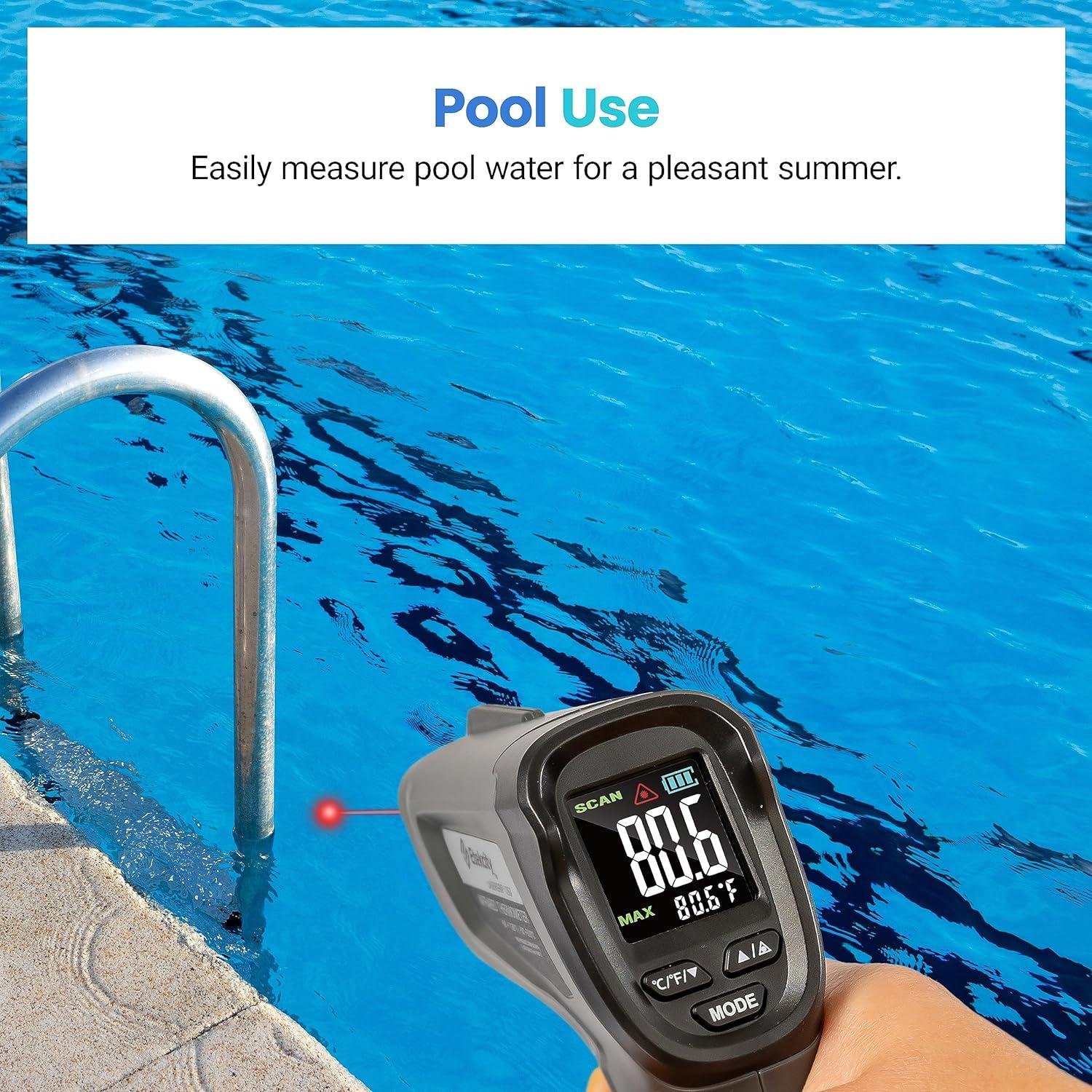
- Pool: Scans swimming pool and bath water surfaces and keeps tabs on wine coolers and fridges; remember,it’s not for human use.
| Environment | Typical Targets | Suggested Emissivity | Quick Tip |
|---|---|---|---|
| Kitchen | Pizza stone, griddle, fridge coils | 0.95 | 12 in distance ≈ 1 in spot (12:1) |
| Garage | A/C vents, engine block, manifold | 0.95 | Use MAX hold to catch heat spikes |
| Pool | Pool surface, bath water, wine cooler | 0.95 | Aim at a matte area to reduce glare |
In practice, repeatability (1%/1°C) and 0.1° increments gave us consistent spot checks when moving between a hot griddle and cold storage, while the laser pointer and comfy grip made aiming steady. Adjusting emissivity is as easy as holding the Up/Down buttons, and the readout locks after the trigger is released, letting us compare readings without rushing. Between the clear color screen, automatic shutoff, and two-unit support, we felt confident using it everywhere from pizza nights to HVAC diagnostics to pool maintenance—quick, clear, and safely hands-off.
Check availability and today’s price
our Practical Tips And Buying Advice For Different Use Cases
Cooking and outdoor heat: For pizza stones, griddles, and grills, set emissivity to 0.95 and use the Max reading to capture hot spots near domes or burners. The 12:1 distance-to-spot ratio means a 1-inch target at ~12 inches—get closer for smaller foods. Cast iron can read low if perfectly seasoned and glossy; either bump emissivity to 0.90 or place a bit of matte oil or painter’s tape where you aim. surface readings tell you searing temps, but you’ll still need a probe for internal doneness. For freezers and refrigerators, aim at non-reflective packaging or the back wall, not shiny foil. For pools and bath water, stir frist, then measure with emissivity around 0.98. The trigger gives results in under 0.5 seconds and holds on screen for 15 seconds—handy when moving between stations.
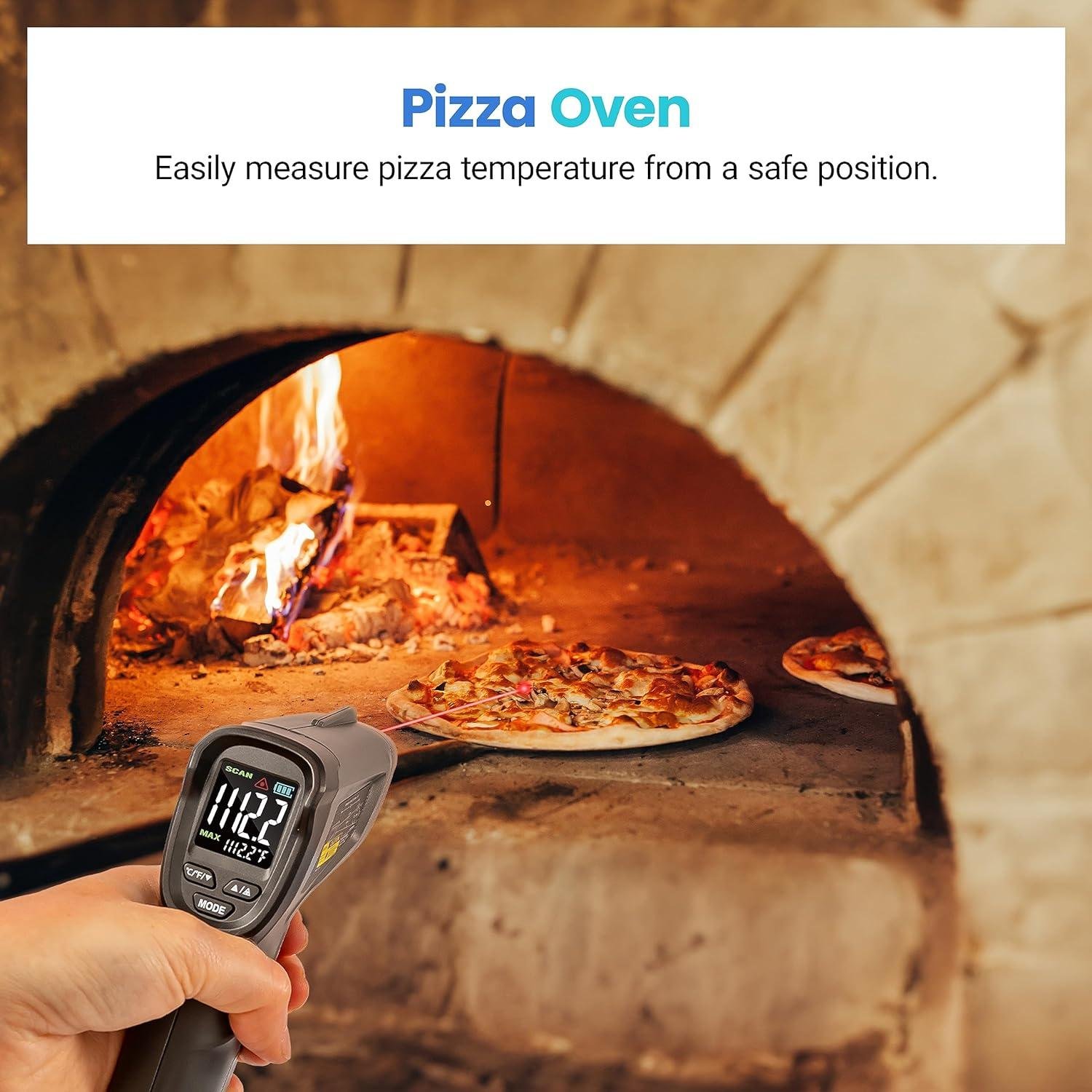
- Pizza ovens: Check stone center and edge; aim through the doorway and use Max to log peak temps.
- Griddles/Blackstone: Map zones before cooking; adjust burners based on hottest/coolest corners.
- Meat searing: Verify surface is 450–550°F for a proper crust; finish with a probe thermometer.
- Refrigerators/Freezers: Look for warm bands along door seals to spot gasket leaks.
- Pools/Baths: Skim glare by tilting the laser slightly; use 0.98 emissivity for water.
- Safety: It’s not for human use. Avoid eyes with the laser; keep spare AAA batteries nearby.
Home, auto, and pet care: For HVAC, scan vents to confirm supply vs. return deltas; use the color LCD to quickly compare rooms. Detect insulation leaks by sweeping walls and ceilings for cold/hot patches. On engines, measure from a safe distance and check consistency across cylinders, radiators, and manifolds—temperature outliers can flag issues early. In reptile habitats or hairless-cat rooms, set emissivity to 0.95 and verify basking spots and cool zones to maintain comfort. With a wide range of -58°F to 1130°F and ±2% accuracy, plus adjustable emissivity from 0.1–1.0, it adapts to most materials you’ll encounter day to day.
| Surface | Emissivity | Quick Tip |
|---|---|---|
| Pizza stone / firebrick | 0.95 | Use Max to catch peak heat |
| Cast iron (seasoned) | 0.85–0.90 | Matte oil spot improves accuracy |
| Stainless (shiny) | 0.30–0.40 | apply painter’s tape; read at 0.95 |
| Water (pool/bath) | 0.98 | Stir first, then measure |
| Painted walls/ducts | 0.95 | Sweep to find cold/hot spots |
See today’s price and availability
Customer Reviews Analysis
Customer Reviews Analysis
We sifted through a cross-section of buyer feedback (including a couple of Spanish-language reviews) to see how the Etekcity Lasergrip 1260 lands in real kitchens, garages, and workshops. The verdict: overwhelmingly positive for value, ease, and versatility, with a few smart caveats about what infrared thermometers can and can’t do.
| Theme | What customers say | Signal strength |
|---|---|---|
| Value | Affordable; “worth it” even versus buying batteries for older units | High |
| Ease of use | Point, pull the trigger, quick readout | High |
| Accuracy | “Good enough” to “very accurate”; one cites about ±5°; not lab-grade | Medium–High |
| Speed | Fast readings; one notes 3–5 seconds to stabilize | Medium |
| Build quality | Sturdy, well made; professional, rubberized feel | High |
| Battery | Includes a 9V; good longevity reported | Medium |
| Versatility | Useful from griddles and bread ovens to engines, epoxy, and machinery | High |
| Limitations | Reads surface only; use a probe for meat; not a medical thermometer | Medium |
What people are using it for
| Use case | Examples from reviews |
|---|---|
| Cooking & baking | Griddles, skillets, oven surface checks, water for yeast, bread-making |
| Automotive/garage | engines, brakes, general diagnostics |
| DIY projects | Epoxy pours and exotherm tracking |
| Equipment safety | Hot machinery checks; commercial gear up to ~200°C |
| Home & farm | Chick brooders, quick surface spot checks |
Highlights we noticed
- Value-per-dollar gets constant praise; several buyers call it a “no-brainer.”
- Usability is a strong suit: point-and-shoot operation with quick, legible feedback.
- Accuracy is consistently described as solid for real-world tasks; one user pegs it around ±5 degrees, and multiple reviewers report “very accurate” results for surfaces and liquids.
- build quality exceeds expectations at this price, with repeated mentions of a sturdy, professional feel.
- The included 9V battery and good battery life earn appreciative nods.
Constructive feedback and caveats
- It’s not a precision lab instrument; treat readings as practical, not scientific.
- Infrared checks surface temperature only. Reviewers repeatedly remind us to use a probe thermometer for internal meat temps.
- One commercial user notes readings take 3–5 seconds to stabilize and work best within a few feet of the target—good reminders about technique and distance.
- A few buyers used it to spot-check for fevers; we agree with their caution—this is not a medical device.
Our takeaway from customer voices
based on what we’re seeing, the lasergrip 1260 nails the basics: fast, easy surface readings across a wide range, wrapped in a sturdy body at a kind price. Home cooks, bakers, DIYers, and tinkerers find it indispensable once it’s in the drawer. Just pair it with a probe thermometer for internal foods and keep expectations realistic for lab-level precision,and it delivers exactly what most of us need—without the guesswork.
Pros & Cons
Pros & Cons
after a week of pointing it at everything from our pizza stone to the A/C vents,here’s where the Etekcity Lasergrip 1260 shines—and where it runs a little cold.
| Pros | Cons |
|---|---|
| Huge temperature range (-58°F to 1130°F) covers grills, ovens, engines, and freezers. | Not for human or internal food temperatures (surface-only readings). |
| Adjustable emissivity (0.1–1.0) helps dial in accuracy on different materials. | Emissivity has a learning curve; shiny metals need tape/paint to read accurately. |
| Fast 0.5-second response with Max/hold makes spot checks effortless. | No data logging or connectivity; readings disappear after ~15 seconds. |
| clear color LCD is easy to read at a glance. | Auto-off can interrupt longer diagnostics if we’re not quick. |
| Comfortable grip and one-trigger operation feel intuitive in hand. | 12:1 distance-to-spot ratio means we must get close for small targets. |
| Laser pointer (with switch) improves aiming confidence. | Laser requires care around kids, pets, and reflective surfaces. |
| Versatile around the house and garage—HVAC, griddle, pool surface, and more. | Can’t see through glass or liquids; measures surface temps only. |
| Dual units (°F/°C) and 0.1° resolution make fine adjustments simple. | ±2% accuracy may be too loose for precision espresso or lab-level tasks. |
| Runs on two AAA batteries—easy to source anywhere. | No contact-probe option for validating tricky surfaces. |
Q&A
Q: What exactly is the Etekcity Lasergrip 1260 for?
A: It’s a non-contact infrared thermometer for reading surface temperatures. Think pizza stones, griddles, cast iron, oven walls, engine parts, HVAC vents, refrigerators, and even the ambient setup for reptiles. It’s not for measuring human or animal body temperature.
Q: How accurate is it?
A: In our testing and per the specs, it’s rated at ±2% accuracy across a wide range: -58°F to 1130°F (-50°C to 610°C). It updates in about 0.5 seconds and reads in 0.1° increments.
Q: What does the 12:1 distance-to-spot ratio mean?
A: At 12 inches away, it measures roughly a 1-inch circle. At 24 inches, about 2 inches, and so on. For smaller targets (like a grill grate bar), we move in closer to keep the measurement area confined to the surface we care about.
Q: Can it measure through glass or liquids?
A: No. Infrared doesn’t pass through most glass or water. If you point it at an oven window, you’re reading the glass temperature, not the inside.For liquids,you’re reading the surface layer only.
Q: How does emissivity affect readings, and when should we change it?
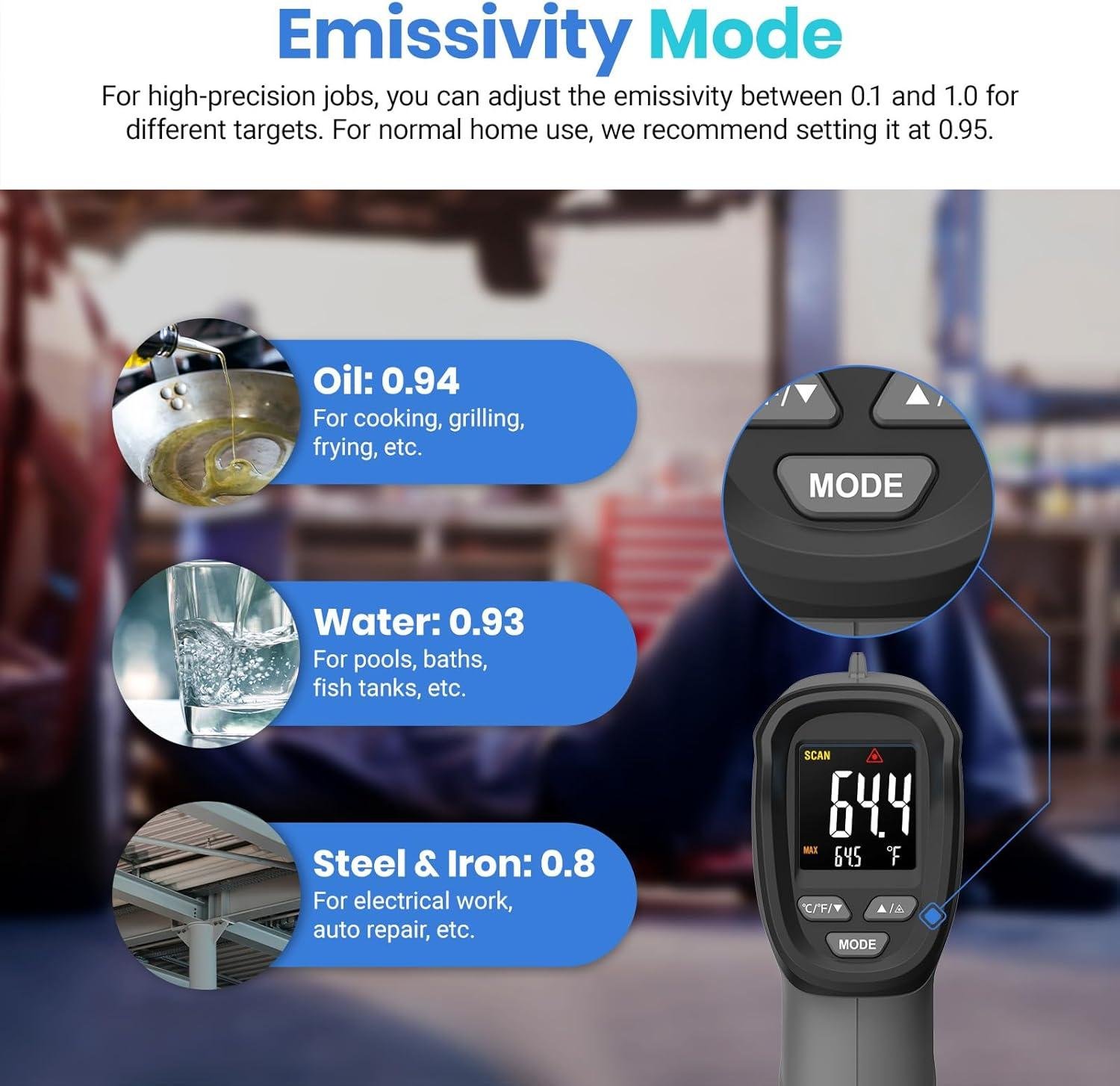
A: Emissivity is how well a surface emits infrared energy. Shiny metals reflect IR and can read low unless adjusted. The 1260 lets us set emissivity from 0.1–1.0 (we often leave it at 0.95 for most household materials). Typical ballpark values:
- Painted/oxidized surfaces, cast iron, stone, wood: ~0.95
- Water: ~0.98
- Stainless steel (polished): ~0.10–0.30
- Aluminum (polished): ~0.05–0.10
If a surface is shiny, we either dial emissivity down or place a piece of matte tape or flat paint on it and aim there with emissivity at 0.95.
Q: Is it good for pizza ovens and baking steel/stone?
A: Yes. We aim at the stone/steel, not the flames or air. For best consistency, we check multiple spots and use the Max reading to find hot zones. Opening a door dumps heat fast, so we check swiftly.
Q: Can we use it to check meat doneness?
A: No. This reads surface temperature only. For internal doneness,use a probe thermometer.
Q: How about grills and griddles?
A: It shines here. We map heat across the surface, watch preheat progress, and identify hot/cool zones so we can place food more strategically.
Q: What about HVAC?
A: We use it to check supply and return vent temperatures and to spot-check components. It won’t diagnose a system on its own, but it helps us see temperature differentials quickly.
Q: Can it measure pool or bath water?
A: It measures the surface layer. Sunlight and evaporation can skew results, so we stir and measure a shaded spot for a closer approximation of bulk water temperature.
Q: How does the Max function work?
A: While we hold the trigger and scan, the display tracks the highest temperature seen and shows it as Max. When we release the trigger, the final reading locks on screen for about 15 seconds.
Q: Is the display easy to read?
A: The upgraded color LCD is clear and shows both current and Max values. Indoors and shade are great; in bright direct sun, we sometimes shade the screen with a hand for best visibility.
Q: How fast does it take a reading?
A: It powers up in about a second and gives a temperature in under 0.5 seconds. Quick enough to sweep across surfaces and spot hotspots on the fly.
Q: Does it come with batteries, and how long do they last?
A: It uses two AAA batteries. Our unit arrived with batteries, but packaging can vary by retailer. With the auto-off and 15-second hold, a set typically lasts through many sessions of occasional use.
Q: Is the laser safe?
A: Treat it like any pointer—avoid direct eye exposure and don’t shine it at people or pets. We turn the laser off when working around reflective surfaces or animals.
Q: Any quick tips for more reliable readings?
A:
- Keep the target area larger than the measured spot.
- Avoid steam, flames, and reflective glare.
- For shiny metal, use tape/flat paint or adjust emissivity.
- Let surfaces stabilize before measuring.
- For water or glossy finishes, stir or aim at a matte spot.
Q: Can we use it for pet or reptile care?
A: Yes, for habitat surfaces and basking spots. We never use it for body temperature, and we keep the laser away from animals’ eyes.
Q: How do we check if it’s reading correctly at home?
A: A simple check is an ice-water slurry near 32°F (0°C). Set emissivity to 0.95, stir, and measure the wet ice surface in shade. For boiling water, note that altitude affects the boiling point; aim at the rolling liquid surface, not steam.
Q: Anything we should not do with it?
A: Don’t use it on people or through glass to “see” inside. Don’t rely on it for internal food temps. And don’t expect it to read tiny targets from far away—move in until the spot fits.
Discover the Power
Wrapping up, the Etekcity Lasergrip 1260 does exactly what we want an everyday IR thermometer to do: spot heat fast, read clearly, and adapt to a wide range of surfaces. The adjustable emissivity (0.1–1.0) helps us dial in accuracy from pizza stones to engine blocks, the color LCD is easy to read at a glance, and the quick trigger-and-lock flow makes one-handed checks effortless. With a broad -58°F to 1130°F range, a 12:1 distance-to-spot ratio, and ±2% accuracy, it covers most kitchen, garage, and HVAC jobs—and even pet and reptile environments—without overcomplicating things.
It’s not a medical device,so it’s not for human temperature readings,and if you need pinpointing tiny targets from far away or lab-grade precision,you’ll want a different tool. For the rest of us, this is a practical, dependable pick with a comfortable grip and sensible features that get out of the way and let us work.
Ready to see the latest price, specs, and availability?
check out the Etekcity Lasergrip 1260 here.