
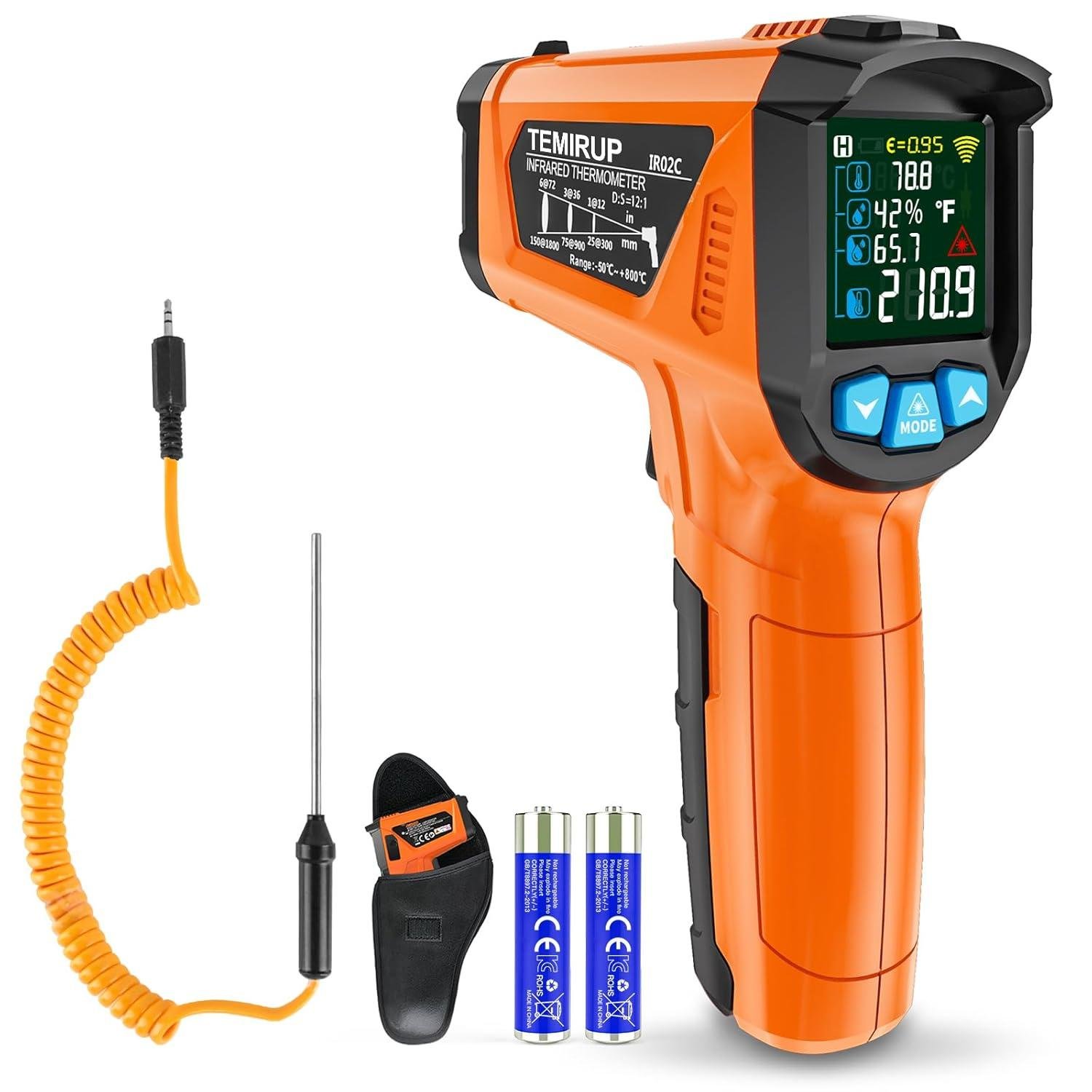
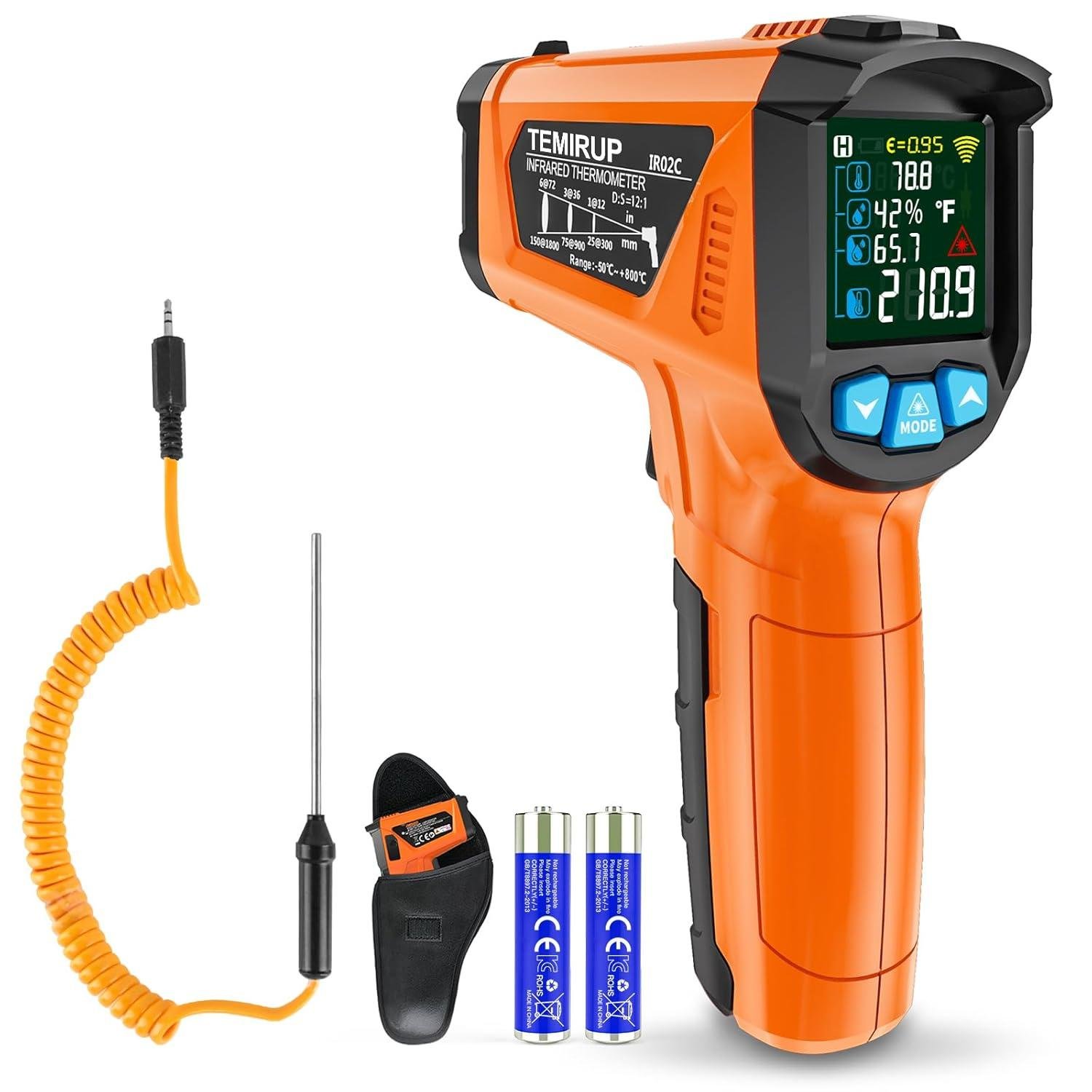
We spent a week pointing this little laser at just about everything we could justify: a sizzling cast‑iron griddle, a humming HVAC register, a kettle on the boil, even the block of an idling engine. The Infrared Thermometer Gun from TEMIRUP promises wide‑range, non‑contact readings from −58°F to 1472°F, a color LCD you can read at a glance, and the sort of extras—adjustable emissivity, ambient temperature and humidity, dew point, and dual alarm modes—you usually see on pricier tools.On paper, it’s versatile: a 12:1 distance‑to‑spot ratio for safer standoff measurements, two ways to measure (single‑point IR and a K‑type probe for direct contact), and alerts that flag potential spoilage/mold risks or unusual temperature deltas. It’s explicitly not for taking human body temperatures, but it’s aimed at the industrial‑to‑everyday middle ground: cooking and griddles, home maintenance, engines, and HVAC checks.
We put it through common scenarios—searing pans, freezer checks, supply/return vent balancing, and surface scans on appliances—and cross‑checked readings against ice‑water and boiling‑water references plus a contact probe on tricky surfaces like shiny metal. We also played with emissivity settings to see how much accuracy we could reclaim on reflective targets and tested the alarm modes during a swift moisture and wall survey.
In this review, we’ll share where the TEMIRUP felt instantly useful, where technique and settings made the difference, and where a single‑spot IR gun simply can’t replace a thermal camera. if you’re considering a budget‑friendly temperature gun for fast diagnostics and kitchen duty, our hands‑on notes should help you decide whether this one earns a place in your toolkit.
Our first impressions of the TEMIRUP infrared thermometer in everyday use
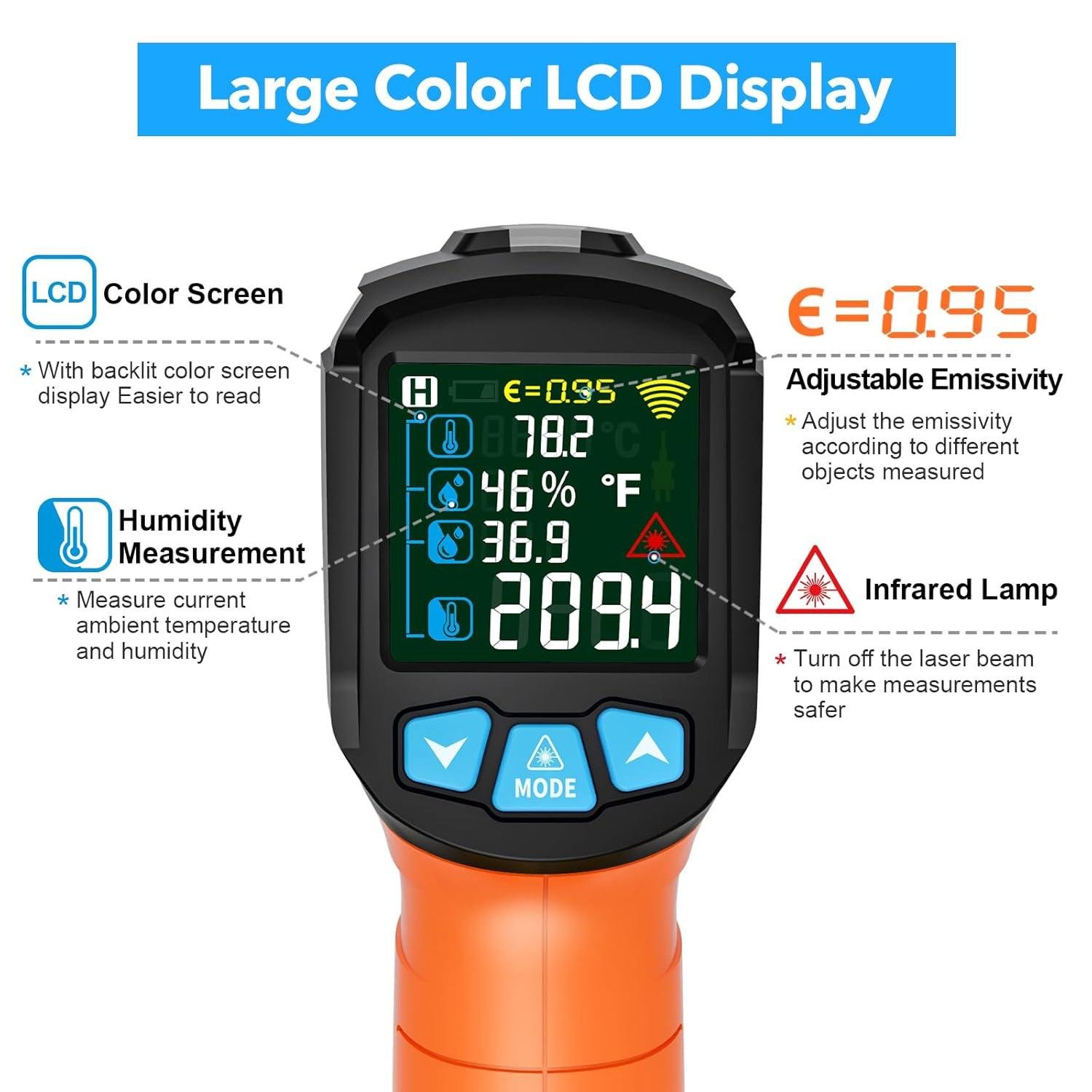
Right away, we appreciated the point-and-measure simplicity, radiant color LCD, and the fact that batteries are included. Readings pop up quickly, and the 12:1 distance-to-spot ratio made it easy to check griddles, HVAC vents, and freezer shelves without crowding the target. The ability to tweak emissivity helped tame reflections on shiny cookware, and the onboard ambient temperature, humidity, and dew point (via an HTU20 sensor) added context for moisture-prone spots. The two alert options—Spoilage Alarm Mode and Temperature Difference Alarm Mode (flags when surface vs. ambient differs by >5°C)—felt genuinely useful for quick household diagnostics. Do note: it’s not for human temperature readings.
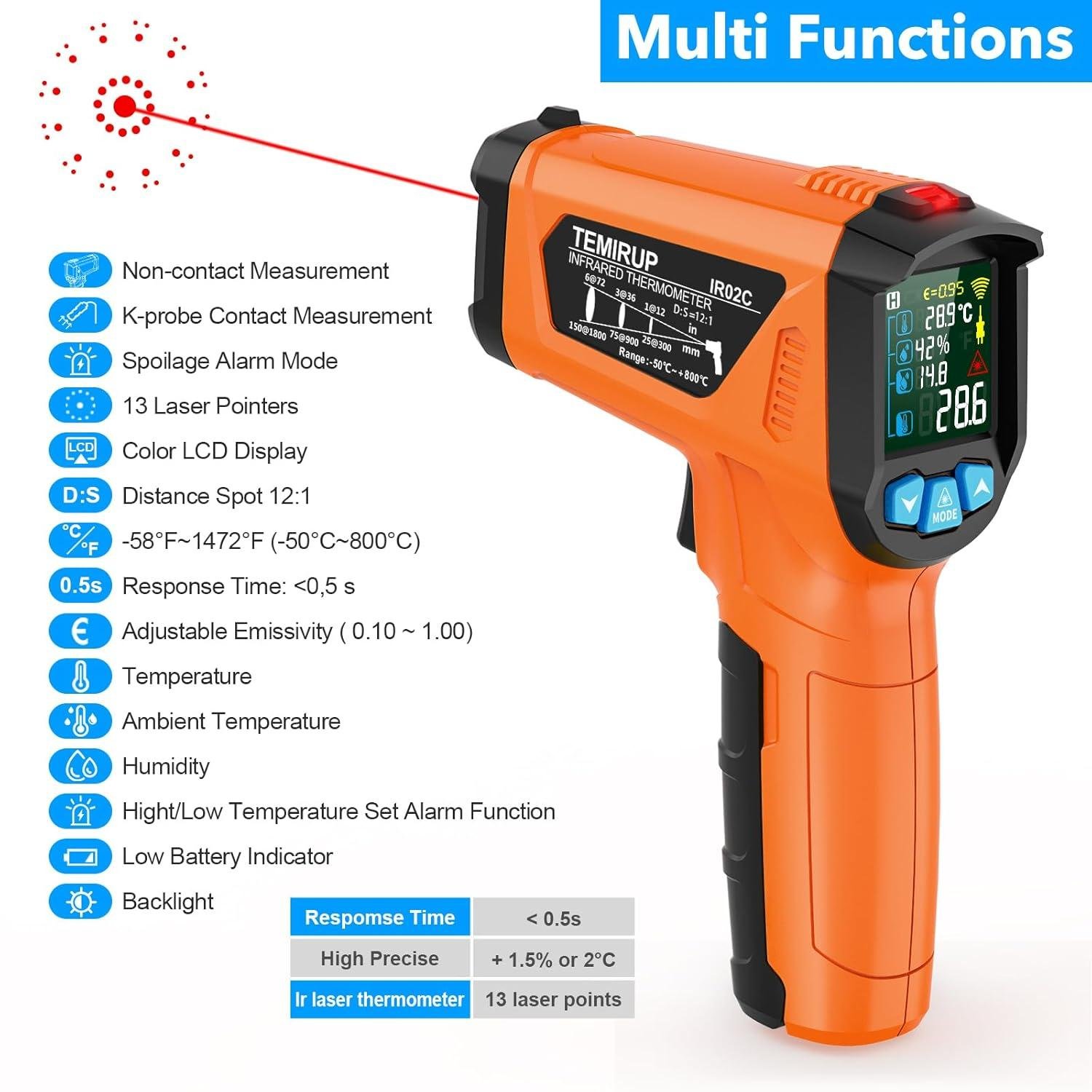
- Speed & clarity: Fast response, easy-to-read display with Max/Hold, °C/°F, and low-battery indicator.
- range: -58°F to 1472°F covers everything from freezers to searing skillets.
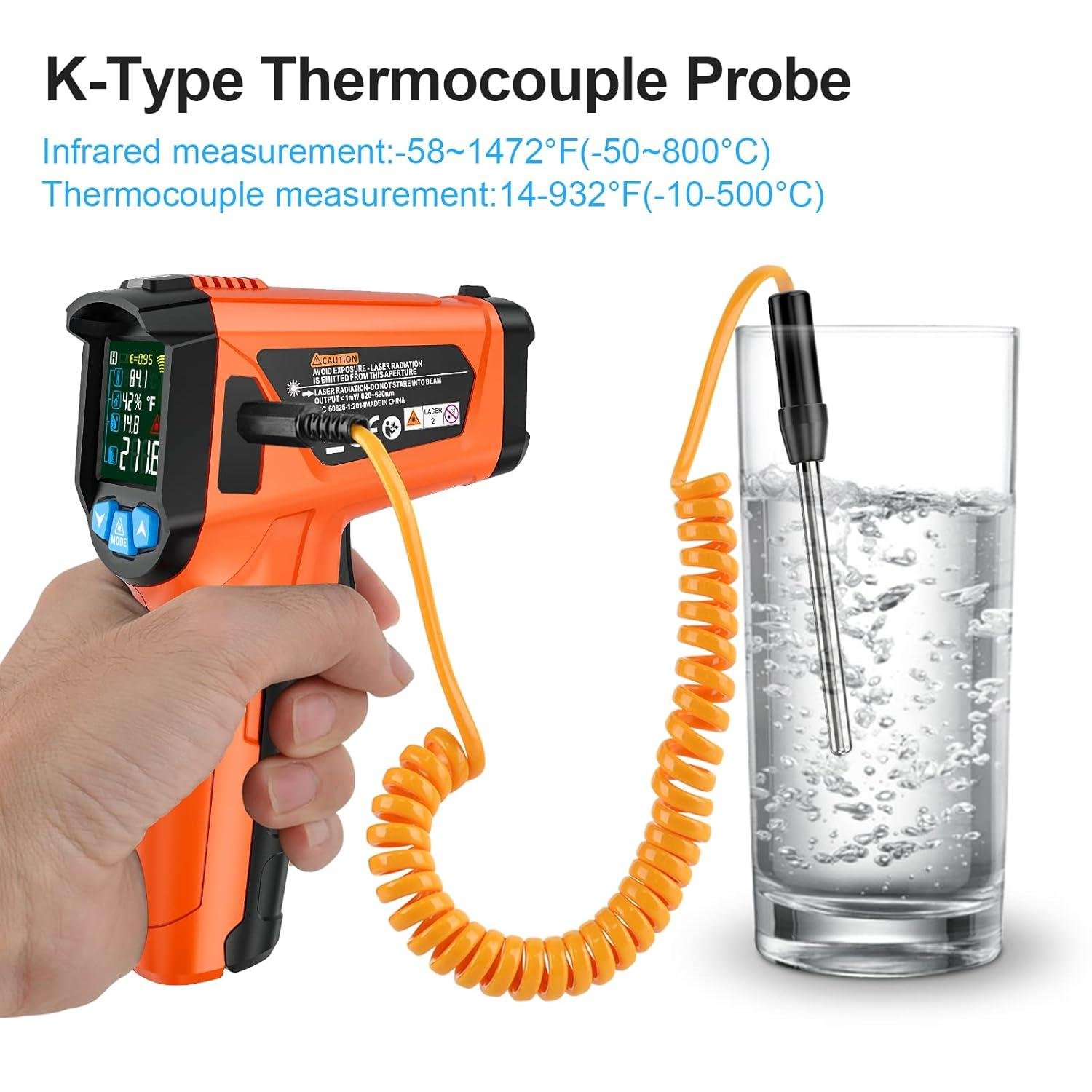
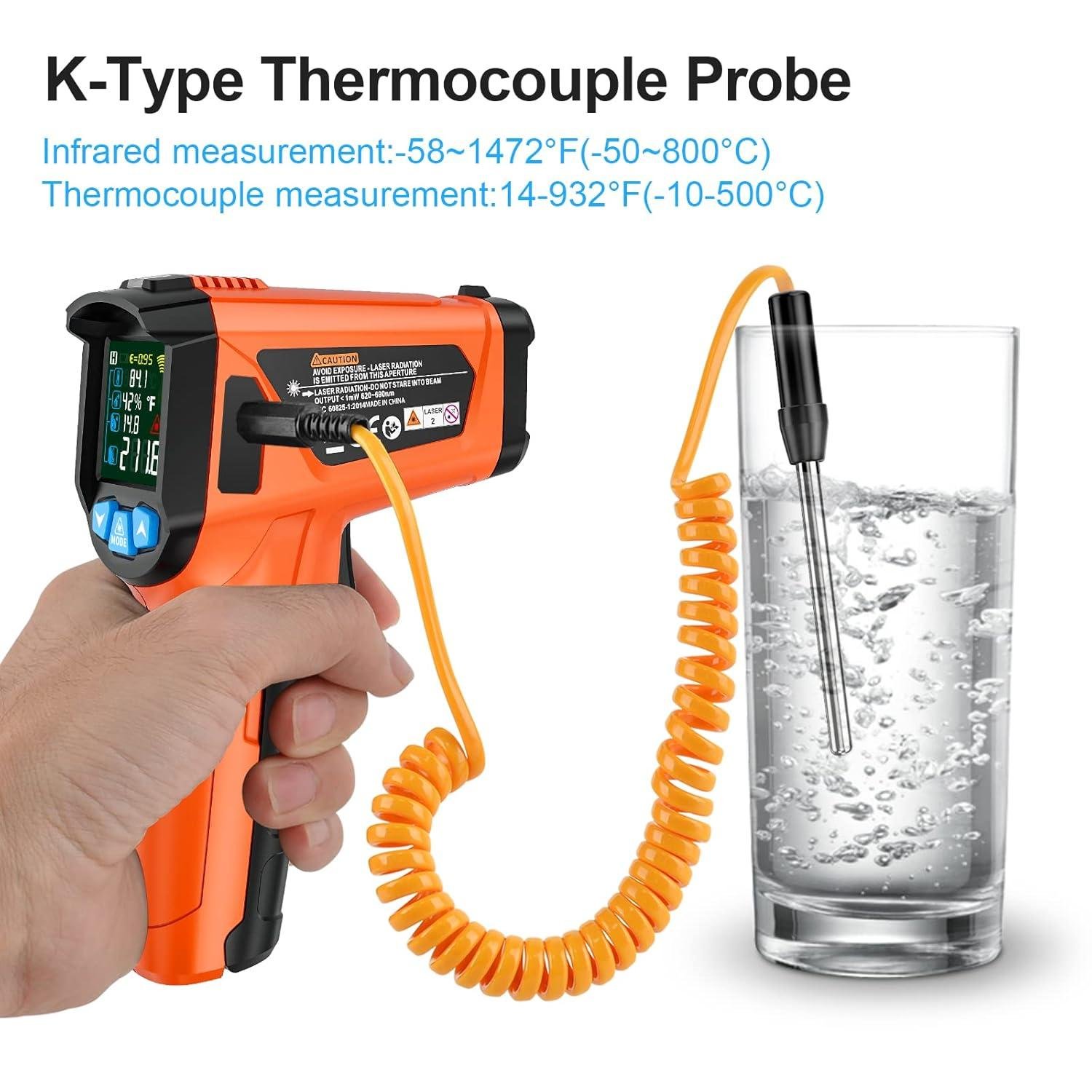
- Two ways to measure: Non-contact laser for convenience; included K‑probe for spot-on confirmation.
- Real-world accuracy: Solid on cookware and vents; like many IR guns,glossy surfaces may fluctuate until emissivity is set. Won’t “see” hot/cold patterns like a thermal camera.
- Power habits: Auto shut-off after 30 seconds preserves battery life.
| Quick take | Our note |
|---|---|
| Display | Bright color LCD; readable at a glance |
| Emissivity | Adjustable—reduces errors on shiny pans |
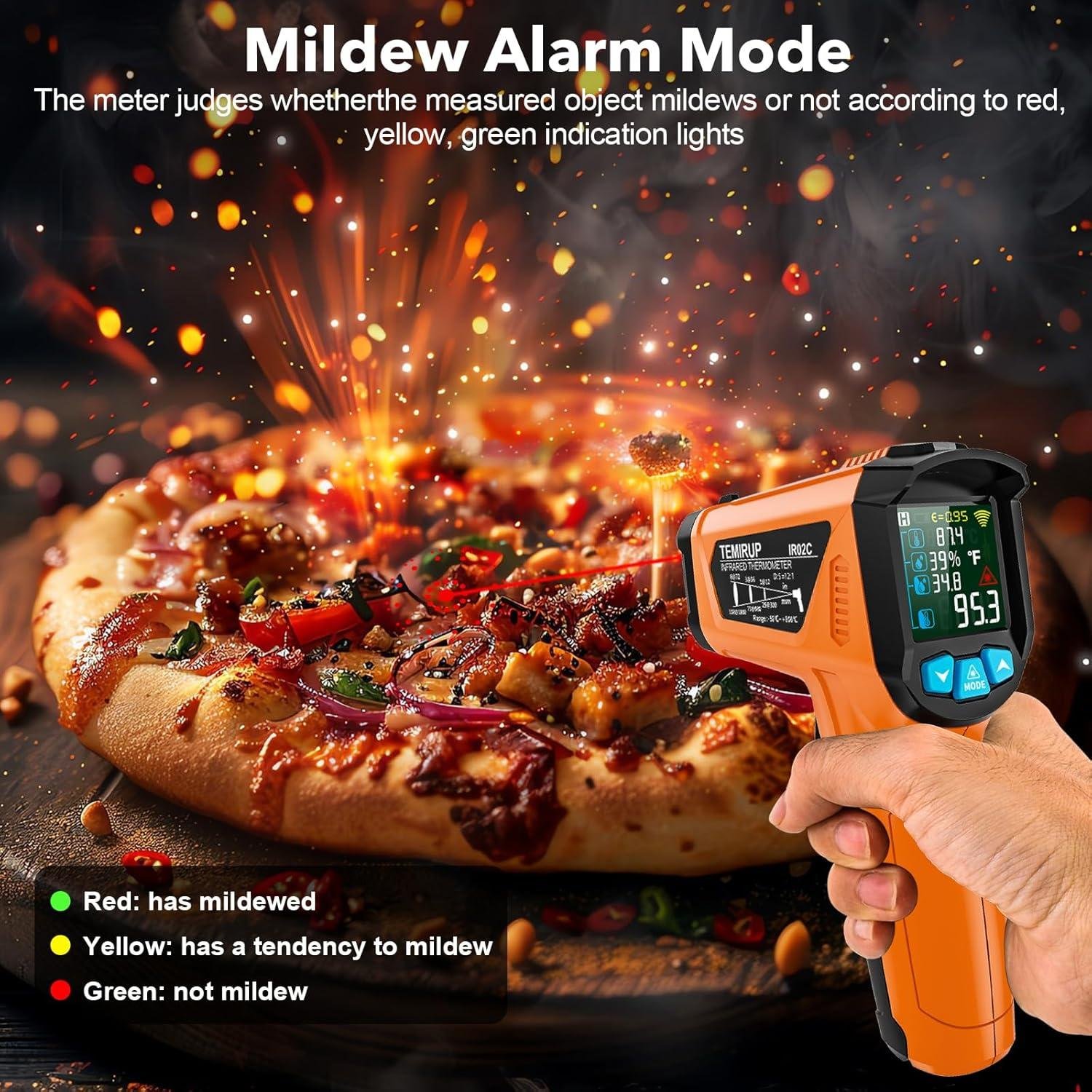
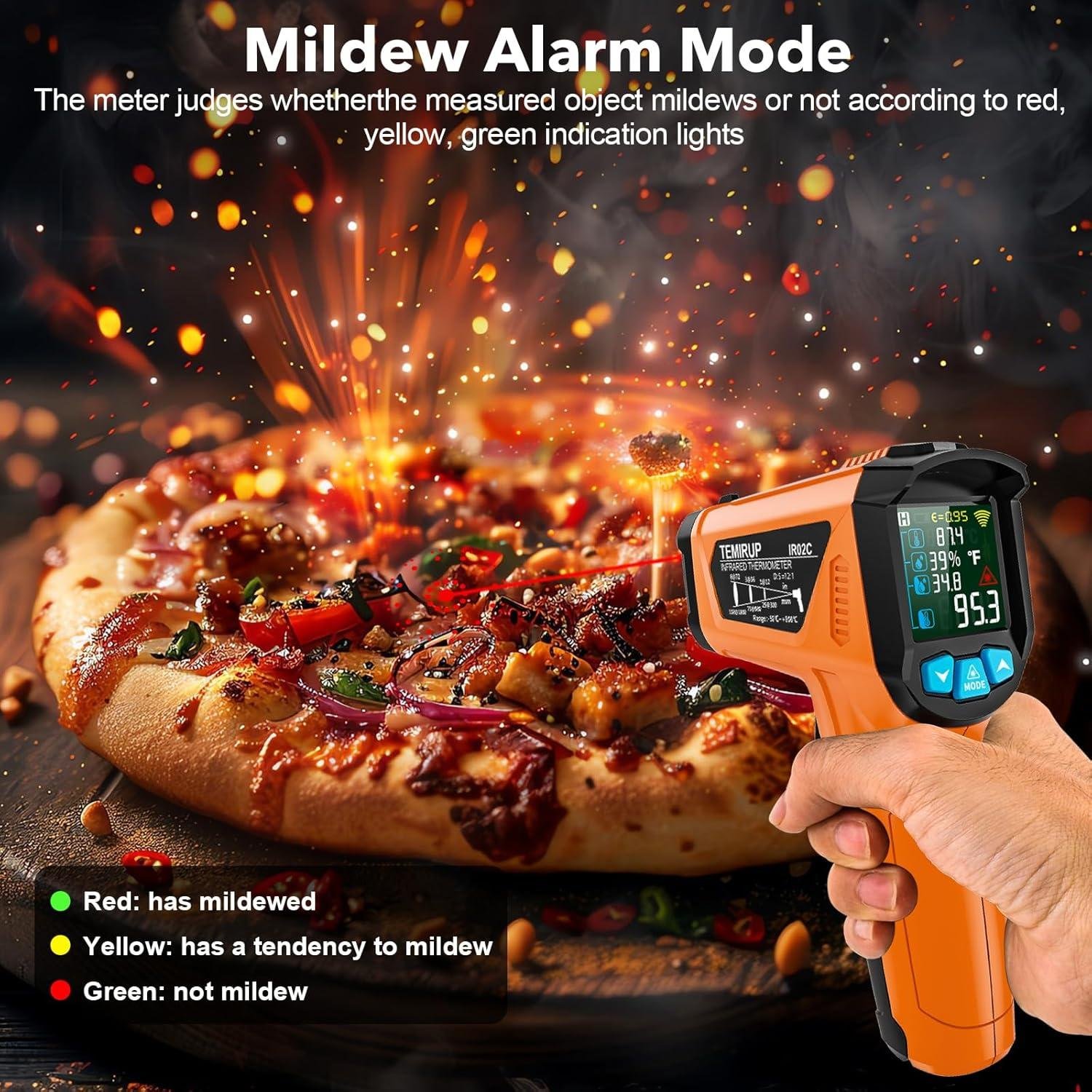
| Alarms | Spoilage + 5°C temp-diff alerts |
| D:S ratio | 12:1; mind your distance for small targets |
| K‑probe | Great for verifying IR readings |
| Everyday use | Griddle, HVAC vents, fridge, bath water |
In our day-to-day checks, it streamlined kitchen tasks (dialing in cast-iron heat, confirming oven hotspots) and helped balance room comfort by comparing vent temps and spotting cold sinks near windows. The humidity/dew-point readout is handy for identifying condensation risks on walls and wood. We found repeatability improves when we: keep a steady distance, avoid glossy angles, use the Hold function for tricky spots, and double-check with the K‑probe when precision matters. Customer feedback echoes a theme we noticed—generally reliable for quick jobs, with mixed opinions on pinpoint accuracy—so it rewards good technique. If that mix of speed, features, and flexibility fits your routine, it’s an easy tool to live with.
Features we leaned on adjustable emissivity color LCD laser targeting and humidity readouts
We leaned heavily on the adjustable emissivity to get trustworthy readings across very diffrent surfaces—cast iron, painted metal, and HVAC ducting—without second-guessing. Pair that with the 12:1 distance-to-spot and laser targeting, and it was easy to stay a safe distance from a sizzling griddle or hard-to-reach engine parts. The color LCD is genuinely helpful in bright kitchens and dim garages alike, and the Max/Hold readouts kept peak temps visible while we repositioned. Accuracy feedback from customers is mixed, so we appreciated having both non-contact scanning and a K‑probe contact mode for spot checks. The wide operating range (-58°F to 1472°F) and quick response made it our go-to for fast diagnostics across home, shop, and cooking tasks. (Note: not for human temperatures.)
- Adjustable Emissivity: Dials in readings on dull vs. shiny surfaces.
- Color LCD: Clear at a glance; easy on eyes in any lighting.
- Laser Targeting (12:1 D:S): Pinpoints the spot you’re measuring.
- Ambient Humidity & Dew Point (HTU20): Adds context for condensation and mold risk.
- Dual Alarms: Spoilage alarm for wood/walls/food; ΔT alarm for >5°C differences.
- Max/Hold, °C/°F, Auto Shut‑Off, Low Battery: Practical day-to-day conveniences.
- Two Measurement Modes: IR scanning plus K‑probe for verification.
The humidity readouts and dew point were surprisingly useful.During wall and duct inspections, the spoilage alarm helped us flag potential problem spots, while the temperature difference alarm quickly highlighted areas running out of spec in steady-state environments. Some users note it’s “quick but not a hot/cold spot mapper,” so we scanned in a simple grid pattern and leaned on the humidity/dew point combo to decide where to follow up with the K‑probe. in short, we used speed for coverage and these environmental metrics for confidence.
| Use Case | What We Adjusted | Outcome |
| Griddle / Cast Iron | Raised emissivity; used Max/Hold | Stable peak temps for searing |
| Shiny Ducting | Lowered emissivity; verified with K‑probe | Consistent readings across passes |
| Wall Check | Humidity + Dew point + ΔT alarm | Fast flagging of suspect zones |
Check availability and today’s price
Performance in the kitchen garage and HVAC bay accuracy responsiveness and handling
In the kitchen, we appreciated the fast response and bright color LCD when checking cast‑iron pans, baking stones, and frying oil from a safe distance (the 12:1 D:S keeps us clear of splatter). Accuracy felt dependable on matte cookware and water surfaces—especially after dialing in adjustable emissivity—and the optional K‑probe contact mode helped when we wanted a definitive reading on shiny stainless or sugar syrups. Ambient temp, humidity, and dew‑point readouts are handy near fridges and freezers, while the Temperature Difference Alarm flags hotspots or cool zones on griddles and ovens. That said, customer feedback notes mixed precision on some surfaces; our best results came from steady aim, filling the target area, and using tape on reflective materials before measuring.
| Use Case | Accuracy | handling | Note |
|---|---|---|---|
| Kitchen | Good w/ emissivity set | Quick, clear LCD | K‑probe for shiny pans |
| Garage | Stable on matte parts | Safe 12:1 distance | Use tape on chrome |
| HVAC Bay | Solid for vents | Easy trigger/Max‑Hold | Alarm aids ΔT checks |
In the garage and HVAC bay, the wide -58°F to 1472°F span let us spot-check rotors, manifolds, and adapters without getting too close, and Max/Hold made it simple to capture peaks. The Spoilage/Mold Alarm proved surprisingly useful around damp walls or crawlspaces. For airflow work, quickly comparing supply vs. return was straightforward, though (as some buyers mention) it’s not a thermal imager—there’s no red/blue heat map, and pinpointing subtle wall gradients takes patience. We did see occasional variance when repeatedly scanning the exact same spot; consistency improved when the surface was stable, the laser dot stayed centered, and emissivity matched the material. HVAC purists may still want a clamp thermocouple for line sets, but we liked having the built‑in K‑probe option for contact verification.
- Adjustable emissivity to match metals, stone, and coatings
- Two measurement modes: non‑contact IR and K‑probe contact
- Dual alarms for spoilage/mold risk and ΔT thresholds
- 12:1 distance‑to‑spot for safer, more precise targeting
- Color LCD with Max/Hold, °F/°C, and auto shut‑off (batteries included)
See today’s price and check availability
Our recommendations dialed in settings use cases and tips for consistent results
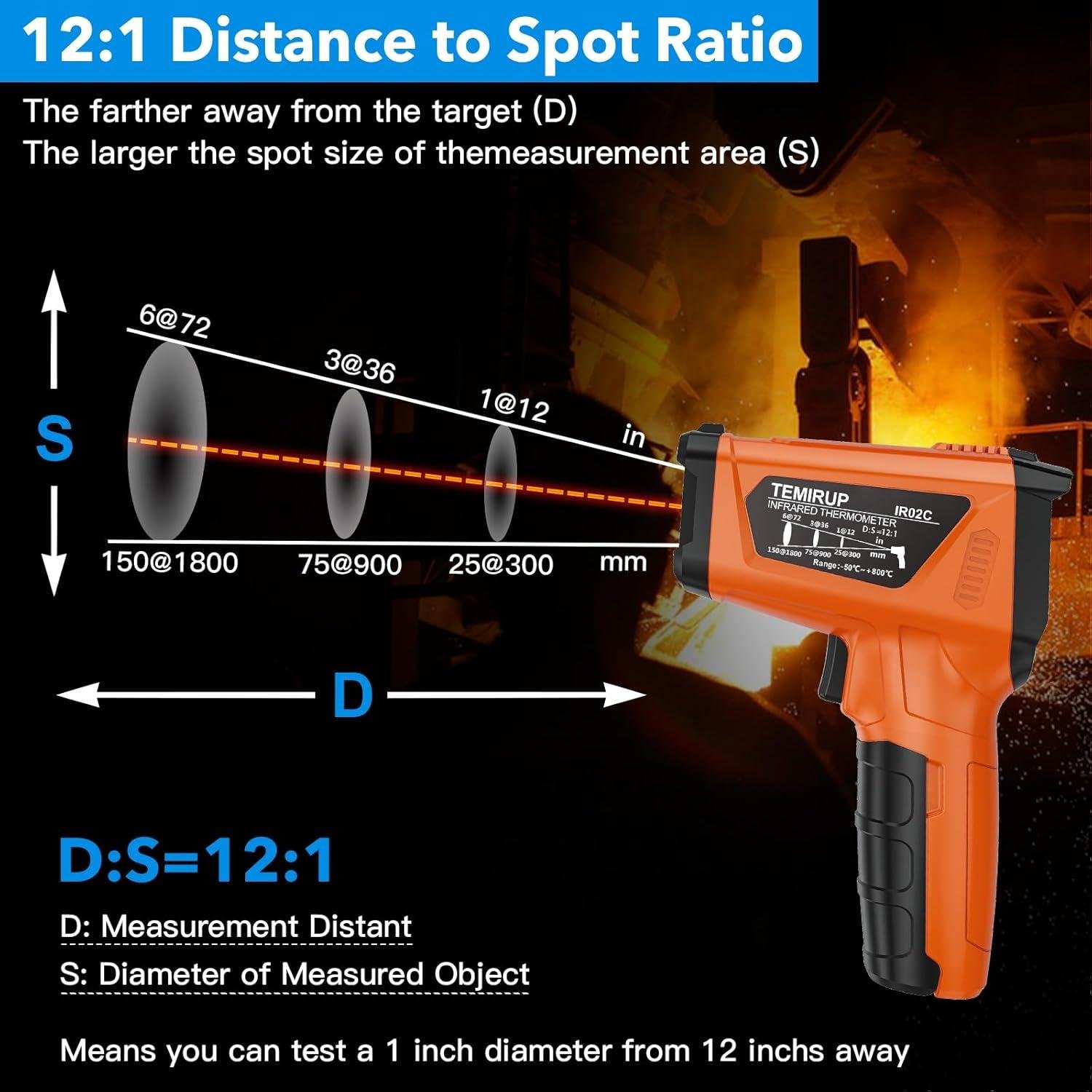
Dial-in settings that worked for us: start by setting emissivity to match your surface, keep the laser perpendicular, and mind the 12:1 distance-to-spot ratio (at 12 inches away you’re reading roughly a 1-inch circle).For shiny metal or glossy paint, readings can drift—either use the included K‑probe, place a strip of matte masking tape on the spot, or dust with a bit of flour/flat black paint to raise emissivity. In HVAC or home diagnostics, enable the Temperature Difference Alarm to flag >5°C deltas between surface and ambient; for wood, walls, and pantry checks, the Spoilage Alarm helps spot conditions associated with mold. To curb the occasional fluctuations some buyers mention, we let the unit acclimate to the room for a few minutes, take three quick pulls of the trigger on the exact same point, and use Max/Hold to capture a stable read. And remember: not for human temperature.
| Material | Emissivity | quick Tip |
|---|---|---|
| Cast iron / matte pan | 0.95 | Ideal for griddles |
| Painted drywall | 0.95 | Scan slowly for hot/cold |
| Water / soups | 0.95 | Stir, then measure |
| Stainless (shiny) | 0.10–0.30 | Use tape or K‑probe |
| Oxidized metal | 0.80–0.90 | Measure straight on |
- Distance discipline: keep the target area larger than the spot size; avoid steam/smoke between lens and target.
- Water and oils: stir, wait 2–3 seconds, then shoot or verify with the K‑probe.
- Griddle and oven stone: take a 2×2 grid of readings and average; use Max to catch peak zones.
- HVAC vents: compare supply vs. room using the Temp Difference Alarm for quick pass/fail checks.
- Moisture/mold scouting: watch ambient RH, dew point, and enable Spoilage alarm on suspect walls and wood.
- baseline check: confirm against ice-water (32°F/0°C) with the K‑probe to build trust in your workflow.
| Distance | Approx. Spot Size | Use case |
|---|---|---|
| 6 in (15 cm) | 0.5 in (1.3 cm) | PCB, small fittings |
| 12 in (30 cm) | 1 in (2.5 cm) | Griddle zones |
| 36 in (91 cm) | 3 in (7.6 cm) | Registers, wall scans |
Best-fit use cases we kept returning to: dialing in pancake griddles and pizza steels; confirming sear temps on cast iron; checking fridge/freezer coils and adapter bricks; scanning engine bay hot spots from a safe distance; and quick room-by-room wall/vent comparisons. The color LCD, Max/Hold, °C/°F toggle, ambient temp/humidity, and auto shutoff made it effortless in practice. When precision really matters on reflective or very small targets, the contact probe earns its keep; for quick, repeatable surface checks on matte finishes, non-contact is fast and reliable. Our final tip for consistency: measure the same way every time (angle, distance, surface prep), and log your go-to emissivity presets for the materials you use most.
Check price, specs, and current deals
Customer Reviews Analysis
customer Reviews Analysis
We went looking for buyer voices on the TEMIRUP Infrared Thermometer Gun—and the room is quiet for now. No customer reviews were supplied to us at the time of writing, so we won’t invent sentiment. Rather, here’s how we’d read early feedback when it arrives, plus what typically matters with IR guns in this class.
What we’ll zero in on when reviews land
- Accuracy and consistency across temps: Are readings stable at both freezing and searing ranges?
- Emissivity ease: Can users quickly dial in settings for shiny vs matte surfaces without guesswork?
- Distance-to-spot targeting: Do people successfully measure small targets without “averaging” nearby heat?
- Display and alerts: Is the color LCD readable in bright kitchens, garages, and outdoors? Are alarms useful, not intrusive?
- Build and heat tolerance: Any mentions of lens fogging, trigger fatigue, or battery door issues near grills/engines?
- Battery life and auto-off: Do users report premature shutoffs or strong endurance?
- Humidity readout reliability: Does the ambient humidity feature track with a known-good hygrometer?
- Use-case fit: HVAC, griddles, engines, and roasters each stress an IR gun differently—do owners call out wins or misses?
Watchlist for TEMIRUP’s IR Gun (based on similar products)
| Theme | What to look for | Green flags | Red flags |
|---|---|---|---|
| Accuracy on varied surfaces | Matte tape vs bare steel, ice bath vs boiling pot | Within a few degrees of known points | Wild swings, “never matches my probe” |
| Distance/spot targeting | Small targets (coils, griddle zones) | Crisp, repeatable readings at range | Averaging nearby heat, vague target size |
| Emissivity learning curve | Switching from chrome to cast iron | Quick tweaks, clear manual cues | “Still off on shiny stuff,” confusing menu |
| Display & alarms | Sunlight legibility, color cues | Readable outdoors, helpful color alerts | Dim backlight, colors hard to distinguish |
| build & heat tolerance | Near grills, engine bays, shop dust | Solid trigger, lens stays clear | Battery door looseness, laser misalignment |
| Battery & auto-off | Day-long jobs, intermittent checks | Long life, sensible timeout | Shuts off mid-task, frequent swaps |
| Humidity readout | Side-by-side with a hygrometer | Within a few %RH of reference | Slow updates, big drift indoors |
| Support & warranty | Calibration questions, replacements | Fast replies, clear terms | silence, hoops to jump through |
how we’ll validate owner claims (and how you can, too)
- Low and high checks: Measure an ice slurry (near 32°F/0°C) and a rolling boil (adjusted for elevation) with matte black tape on the pot.
- Shiny vs matte: Compare a stainless pan to the same pan with a strip of matte tape; adjust emissivity until they agree.
- Targeting reality check: Back away from a coin-sized target and watch when readings start to average the surroundings.
- Cross-compare: Spot-check a griddle or HVAC vent against a trusted contact probe; expect surface-only differences on food.
- Humidity sanity test: Park the unit next to a room hygrometer for 10 minutes and log the drift.
Bottom line on reviews (for now)
With no customer reviews in hand, our stance rests on the spec sheet: a very wide temperature range, non-contact operation, color LCD, adjustable emissivity, and a humidity readout.that’s a compelling toolkit—if accuracy, targeting, and day-to-day ergonomics hold up. As buyer feedback emerges, we’ll update this section to reflect real-world wins and wrinkles. If you’ve used this TEMIRUP model, tell us what rang true—and what didn’t.
Pros & Cons
Pros & Cons
What We Liked
- Wide temperature range (-58°F to 1472°F / -50°C to 800°C) covers kitchens, garages, and job sites.
- Dual measurement options: non-contact IR plus support for a K‑type contact probe when precision matters.
- adjustable emissivity, with on-screen ambient temp, humidity, and dew point to better tune readings and spot mold-risk conditions.
- Two smart alarms: spoilage/mildew alert and ΔT alert (±5°C) for quick anomaly checks on walls,ducts,and appliances.
- Color backlit LCD, Max/Hold, °C/°F toggle, auto shutoff, and batteries included—easy to read and ready to go.
- 12:1 distance-to-spot ratio keeps us safely back from hot grills, engines, and griddles while still landing on target.
- Fast,point-and-shoot operation with a laser pointer that simplifies aiming.
Where It Fell Short
- Mixed accuracy and repeatability in user feedback—especially on shiny or uneven surfaces—so technique and emissivity tuning are essential.
- 12:1 optics limit small-target work; you’ll need to get close to measure tiny components accurately.
- Not a thermal imager—no red/blue heat map for finding wall hot/cold spots at a glance.
- Not for human body temperature; this is a surface-only tool.
- Better suited to standard K‑type probe contact than to pipe clamp probes, so HVAC pros may still want a dedicated clamp sensor.
- As with any IR gun, the laser dot is smaller than the actual measurement area; the spot “cone” can mislead if you’re too far away.
Quick Fit Guide
| Shines When | Falls Short If |
|---|---|
| Checking griddles, pizza steels, and pans fast | You need mapped hot/cold spots on walls |
| Comparing HVAC supply vs. room air (ΔT alarm) | Measuring tiny parts from a distance |
| Screening for moisture/mold risk (RH + dew point) | Reading glossy metals or liquids without prep |
| Spot-checking engines and appliances safely | You require lab-grade repeatability every time |
Pro tip we found helpful: for reflective surfaces, set emissivity appropriately and place a small patch of matte tape or flat paint on the spot before measuring to stabilize readings.
Q&A
Q: What’s the headline on specs?
A: A very wide range (-58°F to 1472°F / -50°C to 800°C), non-contact IR with a laser pointer, adjustable emissivity, a color LCD that shows ambient temp/humidity/dew point, two alarm modes, Max/Hold, °C/°F toggle, auto shut-off, and support for a K-type probe contact mode. Distance-to-spot ratio is 12:1.
Q: How big is that 12:1 spot in real life?
A: Think “one inch of target for every foot of distance.” At 12 inches away, you’re sampling roughly a 1-inch circle; at 24 inches, about 2 inches. For small targets, move closer so the spot is smaller than the area you’re measuring.
Q: Is it accurate?
A: Mixed. For matte, non-reflective surfaces and sensible technique, we’ve found readings good enough for everyday tasks. Reports are more inconsistent on shiny metals, small targets, or when distance/emissivity are off. When precision truly matters, use the K-probe or a reference method.
Q: Why do readings sometimes fluctuate?
A: Common culprits:
- Reflective surfaces (polished metal, glossy pans) reflecting ambient or flame heat
- Spot size larger than the target
- Changing distance or angle between shots
- Emissivity not matched to the material
- Measuring near edges, vents, or drafts
Stabilize your position, adjust emissivity, and favor matte targets for steadier numbers.
Q: What’s the deal with adjustable emissivity?
A: Different surfaces radiate heat differently.Emissivity lets us tune the gun so it “expects” the right behavior. Matte paint, electrical tape, wood, and most organics are higher emissivity; polished metals are low. When in doubt, put a small patch of matte black tape on the surface and aim at that.
Q: When should we use the K-type probe rather of IR?
A: – Shiny or reflective materials (stainless, aluminum)
- Liquids where surface steam or ripples trick the IR sensor
- When you need repeatable, contact measurements (e.g., calibration checks)
Note: Confirm whether a probe is included; the unit supports one.
Q: Can we use this for people or pets?
A: No. It’s not a medical thermometer. It’s designed for surfaces, tools, food prep gear, and building materials.
Q: How does it handle cooking tasks?
A: Great for surface checks on griddles, cast iron, pizza steels, and pans. Keep these tips in mind:
- Aim at dark,matte areas; avoid mirror-like stainless
- Get close enough so the spot is smaller than your steak/pancake
- Use Max/Hold to catch peak temps
- For liquids,a quick K-probe dip yields more reliable numbers than IR
Q: Will it help with HVAC and home diagnostics?
A: Yes,for quick supply/return vent checks,radiator and baseboard temps,or comparing surfaces for drafts and insulation issues. It’s a spot reader, not a thermal camera—so you won’t get a red/blue heat map, just single-point temps. Scan methodically if you’re hunting for hot/cold zones.
Q: What are the two alarm modes actually good for?
A: – Spoilage Alarm: Flags conditions associated with mold-prone surfaces (think damp walls or wood). It’s an indicator, not a mold test.
- Temperature Difference Alarm: alerts if a surface is a set amount above/below ambient (handy in controlled environments to catch outliers).
Q: How fast are the readings, and is the display useful?
A: Readings pop quickly, and the color LCD is easy to parse at a glance.Max/Hold, battery indicator, °C/°F switch, and ambient temp/humidity/dew point readouts are all practical in day-to-day use.
Q: Any pro tips to improve consistency?
A: – Match emissivity to your material (or aim at a strip of matte black tape)
- keep the same distance and angle for repeated shots
- Make sure the spot is fully on the target
- Avoid steam/flame flicker and moving air
- For verification, compare against an ice-water slush (~32°F/0°C) or boiling water (adjusted for elevation), ideally with the K-probe
Q: What’s the biggest caveat?
A: It’s a single-spot IR tool. It excels at quick checks across a huge temperature range, but it’s not a substitute for a thermal camera or a calibrated contact thermometer when you need certified accuracy or image-based diagnostics.
Q: Who is this best for?
A: Cooks, tinkerers, and DIYers who want fast surface temperatures on grills, griddles, engines, and around the house; HVAC hobbyists doing quick deltas; anyone needing a broad range with the option to step up to contact measurements. Less ideal for users who require logged data, wireless integrations, or lab-grade precision.
Q: Any safety reminders?
A: Don’t point the laser at eyes. Avoid treating it as a medical device. Be cautious around hot equipment and live electrical panels. And remember: shiny metal lies—matte is your friend.
Reveal the Extraordinary
Wrapping up,TEMIRUP’s IR Gun delivers on range and ease: a broad -58°F to 1472°F span,a clear color LCD,adjustable emissivity,ambient humidity/dew point readouts,dual IR and K‑probe modes,and handy alarms. The caveats are predictable for this class—accuracy and repeatability depend on surface type, distance-to-spot (12:1), and setup.It’s quick and convenient for spot checks; for tight tolerances or shiny metals, the K‑probe or a higher‑end instrument will inspire more confidence. And remember, this is not a thermal camera and not for human temperature.
We’d reach for it when we want fast, non-contact reads on grills, griddles, HVAC vents, engine components, or appliances. We’d look elsewhere if we need a thermal map of walls, pro-grade energy audits, or lab-level precision.Pro tips we found helpful:
– Match emissivity to the surface (use tape or flat paint on reflective targets).
– Mind the 12:1 distance-to-spot so your target fills the measurement area.
– Use the included K‑probe when accuracy matters most.
If that mix of versatility and speed fits your toolkit, see specs, price, and availability here:
Check the TEMIRUP Infrared Thermometer Gun on Amazon